
From the dampness of Auckland to the dry cold of Central Otago, New Zealand’s diverse climate presents real challenges for wine collectors. Understanding how local conditions affect storage (and how to respond to them) is essential for anyone who wants to protect a collection over time.
New Zealand produces some of the finest wine in the world, but the country’s weather patterns make proper storage more demanding than many homeowners initially expect. Conditions vary considerably depending on location, with coastal humidity, seasonal temperature swings, and maritime weather systems all capable of affecting how a bottle ages.
Wine performs best when its environment remains stable. Fluctuations in temperature cause the liquid inside the bottle to expand and contract, placing repeated stress on the cork seal. Over time, this movement allows small amounts of air to enter the bottle, gradually stripping the wine of its more delicate characteristics. Industry guidance commonly places optimal long-term storage at around 12–14°C, with consistently managed humidity.
The Challenges of Storing Wine in Auckland and the North Island
The upper North Island presents a particular set of humidity-related challenges. Moisture levels can remain elevated for extended periods, and while a certain degree of humidity is beneficial for maintaining cork integrity, excess dampness creates conditions in which mould can develop on labels. For collectors who view wine as an investment, label condition has a direct bearing on resale value. Effective storage in this region requires a system that actively regulates humidity, ideally maintaining levels between sixty and seventy percent.
Wine Storage in the Colder, Drier South Island
Central Otago and Canterbury present the opposite challenge. Winters are cold and summers can be intense, and throughout much of the year the air is notably dry. Low humidity poses a significant risk to natural corks, which can lose their elasticity within a matter of months when moisture is insufficient. A compromised cork seal allows air ingress and accelerates spoilage. Introducing a controlled level of humidity into the storage environment is essential for collections in these regions.
Variable and Wind Exposed Regions
Wellington’s reputation for strong, unpredictable winds has practical consequences for wine storage. Older homes in particular can struggle to maintain a consistent internal temperature when exposed to the elements. Addressing this requires thorough insulation, careful draught-proofing and a dedicated cooling system capable of holding a stable temperature regardless of external conditions.
Designing the Right Storage Solution
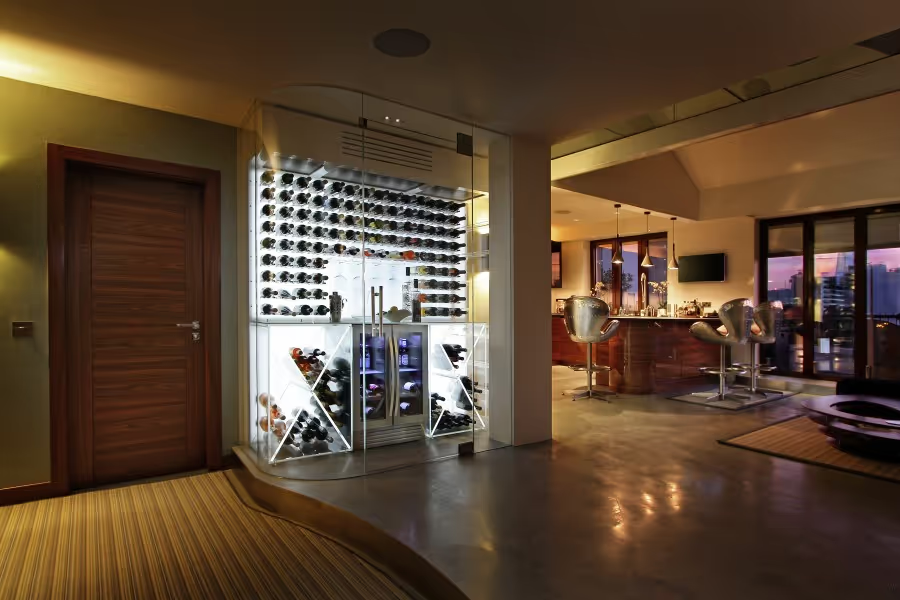
The right approach will depend on the scale of the collection and how it fits within the home. For many homeowners, wine walls and integrated cabinetry offer an elegant solution, while fully climate-controlled units that manage both temperature and humidity while making the collection a feature of the living space.
For larger collections or those requiring more precise conditions, a dedicated custom wine room or cellar provides a purpose built microclimate that operates independently of whatever the weather is doing outside. Getting the design right involves careful consideration of insulation, vapour barriers, and the appropriate cooling system for the specific region.